What Is Benefits Administration? Complete Guide for HR Teams
Learn what is benefits administration, how it works, examples, HR responsibilities, benefits administration challenges and how software can simplify the process.
Benefits administration doesn’t end at enrollment; it ends when premiums paid match who’s covered.
Benefits are 30% of compensation cost, so invoice errors are budget errors.
Most errors start when HRIS, carrier, and payroll each hold a different version of one election.
A terminated employee left on an invoice costs about $817 a month; five of them, $12,255 a quarter.
If you are asking what is benefits administration, here is the short answer. It is the work of running an employer's benefits program: choosing plans, enrolling people, sending elections to carriers and payroll, paying premiums, and proving the numbers match. This guide covers the full cycle: worked examples, who owns each piece, where it breaks, and what software changes. Most readers arrive with a carrier invoice that does not match the headcount.
What Is Benefits Administration in HR?
In HR, it is the function that designs, enrolls, funds, and audits every benefit an employer offers, and that keeps the records carriers, payroll, finance, and regulators rely on. A working benefits administration definition runs from plan selection through premium payment and the monthly proof that payments match coverage.
What Does Benefits Administration Include?
Medical insurance is the most common benefit employers offer.
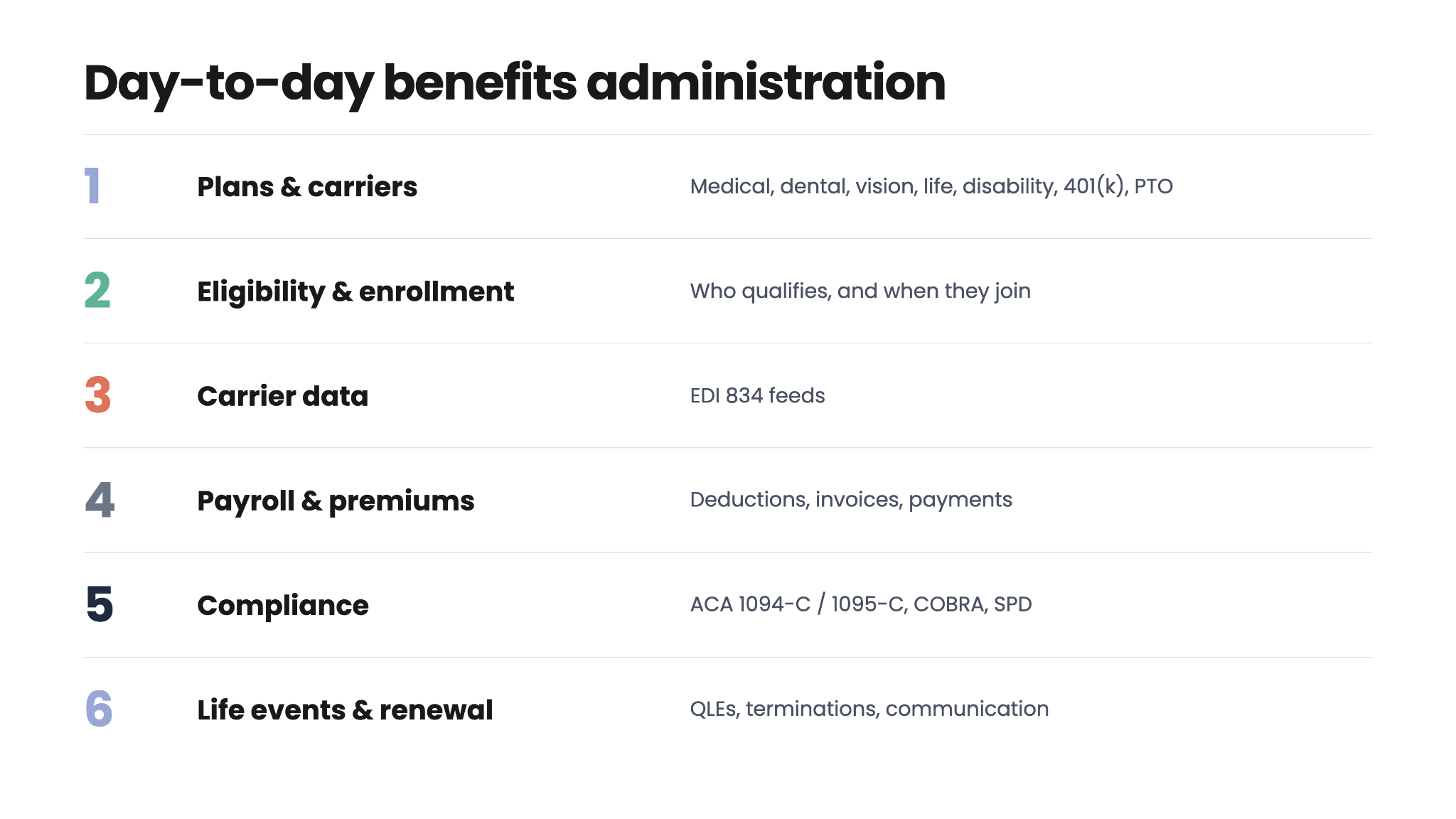
Day to day, employee benefits administration includes:
• Plan design and carrier selection: medical, vision, dental, life and disability, retirement plans such as a 401(k), paid time off
• Eligibility rules and enrollment
• Carrier data exchange through EDI feeds (electronic data interchange files that move elections to carriers)
• Payroll deductions, invoice reconciliation, and premium payment
• Compliance: Affordable Care Act (ACA) Forms 1094-C and 1095-C, COBRA notices, and the summary plan description (SPD)
• QLEs, terminations, employee communication, and renewal
Why Is Benefits Administration Important?
Cost first. According to the U.S. Bureau of Labor Statistics (September 2026), benefits made up 30.0% of employer compensation costs for private-industry workers in June 2026, nearly a third of total compensation, life insurance and disability included.
Money at risk. According to KFF (October 2026), the average annual premium for single-coverage medical insurance in 2026 is $9,804, roughly $817 a month. As an illustration, each terminated employee left on an invoice costs that much monthly.
Compliance. ACA reporting and COBRA notices draw on the same enrollment records, so benefits administration errors become reporting errors. The benefit for companies that get this right is predictable premium spend.
How Does Benefits Administration Work?
The benefits administration process is a yearly cycle with weekly changes in between. The nine steps follow the data from census to audit.
1. Assess Employee and Business Needs
HR and finance start with the census: age bands, dependents, locations, and the carrier's plan experience reports, plus a survey as the first point of employee involvement. Output: a needs summary and a monthly budget ceiling per employee.
2. Select Benefits and Providers
Most benefit administration choices start here. Your broker runs the request for proposal (RFP) and returns quotes. Compare benefits packages on employer contribution, network fit, and renewal-rate caps, not premium alone.
Output: signed plan documents and rate sheets, including retirement plans, another common benefit with its own vendor.
3. Configure Benefits Plans
Build each plan in the human resources information system (HRIS) or ben admin platform: eligibility rules such as first of the month after 30 days, four coverage tiers, rate tables, effective dates. Output: a plan catalog tested with one sample employee.
4. Communicate Benefits to Employees
Publish the enrollment calendar, a plan comparison, and each plan's summary of benefits and coverage (SBC), so employees get educated answers before they ask. An email newsletter sequence works: two weeks out, opening day, three days before close. Output: a communications calendar with owners.
5. Enroll Employees
New hires enroll inside their waiting period. Everyone else enrolls at open enrollment, typically two to four weeks in the fall for a January 1 plan year. Verify dependents. Output: election records with effective dates, waivers included.
6. Sync Benefits Data With Payroll and HR Systems
Each election must reach two places: the carrier, through managed EDI 834 carrier feeds or a portal, and payroll, as a per-pay-period deduction (employee share divided by pay periods). Output: carrier confirmations and a deduction register.
7. Manage Ongoing Changes
Qualifying life events run on a clock, typically 30 days. Marriages, births, and loss of other coverage change tiers. Terminations trigger COBRA notices and must reach the carrier. Output: a dated change log.
8. Reconcile and Audit Benefits Data
Run the three-way match on every invoice: enrollment system against carrier invoice against payroll deductions. Tag each variance as timing (a change after the invoice cut) or error (a termination never sent, a wrong tier), request credits, fix the feed. Output: a dollar-totaled variance report.
9. Review and Improve the Benefits Program
Pick three to five key performance indicators (KPIs): enrollment completion rate, invoice variance rate (lines corrected divided by lines billed), days from invoice receipt to payment, premium leakage recovered, questions per 100 employees. Review quarterly and before renewal.
Benefits Administration Examples
Picture a 600-employee manufacturer. These five benefit administration examples follow it through one plan year.
Example 1: New Employee Enrolls in Health Insurance
A machinist starts March 10 and enrolls in medical insurance on day three. With a 30-day waiting period and a first-of-the-month rule, coverage starts May 1. The HRIS sends the add on the 834 feed and payroll starts the deduction. If the feed fails, she finds out at the pharmacy.
Example 2: Employee Adds a New Child to Their Benefits
A welder's daughter is born June 14, a qualifying life event with a 30-day window. The tier moves from employee plus spouse to family on June 14, so July's invoice carries a retroactive charge and payroll catches up over two checks. Miss the window and the child waits for open enrollment.
Example 3: Annual Open Enrollment
Enrollment runs November 2 through 13 for a January 1 plan year. All 600 employees confirm or change elections (active enrollment). New rate tables load into payroll in December and carriers get full files. The January invoice gets a line-by-line audit because rate-load errors surface there first. This open enrollment guide for employers has the calendar.
Example 4: Employee Leaves the Company
A shift lead resigns August 20, and coverage runs through August 31 under the end-of-month rule. HR sends the termination on the 834 feed that day, and the COBRA election notice follows on a federal deadline measured in days (Department of Labor employer's guide to COBRA). If the termination never reaches the carrier, September's invoice still bills the shift lead: premium leakage.
Example 5: Benefits Invoice Does Not Match Enrollment Data
The October invoice bills 612 lives for medical insurance against 604 in the enrollment system. The eight: five terminated employees never removed (error), two hires added after the cut (timing), one wrong tier (error). At roughly $817 a month, the five terminations cost about $4,085 monthly, or $12,255 a quarter. Log the variance, request the credit, fix the feed, pay the corrected amount.
Example 6: Consolidated Billing - How to Create a Self-Bill
Most carriers send a list bill built from their records. A self-bill reverses that: you calculate what is owed from your enrollment and remit it with a census, so the carrier reconciles to your records instead of the other way around. By hand that is one spreadsheet per carrier each month, and in self-billing software it comes straight from the enrollment system. To build one:
1. Pull enrollment by plan and tier at the billing date.
2. Apply the current rate table.
3. Add retroactive adjustments since the last bill as dated lines.
4. Total by carrier, then by cost center or client.
5. Remit with the census and keep the file.
Who Is Responsible for Benefits Administration?
In-house, HR or the benefits manager owns employee benefits administration and the company benefits budget, but four other roles hold pieces.
Department size decides how many of these roles one person covers. Outsourced, a PEO, ASO, or TPA runs this table for many clients at once, each with its own carriers and invoice formats.
Role
Owns
Typical artifact
HR or benefits manager
Program, eligibility, enrollment
Election records, change log
Payroll
Deductions
Deduction register
Finance or accounts payable
Premium approval, payment
Paid invoices, variance report
Broker
Plan selection, renewal
RFP results, rate sheets
Carrier
Coverage records, invoicing
List bill, feed acknowledgments
The Biggest Benefits Administration Challenges
These teams are rarely careless. They are under-resourced and working across three systems that disagree. The same patterns show up in benefits administration everywhere:
• Three records of one election: HRIS, carrier, and payroll disagree for months
• Invoices arriving as spreadsheets
• Manual Excel reconciliation, substantial matching work done by hand the night before the invoice is due
• Premium leakage: terminated employees still billed
• Retroactive adjustments landing two invoices after the change
• Compliance clocks that keep running: ACA reporting, COBRA notices, QLE windows
For outsourcers and brokers, multiply every line by the number of clients and carrier formats.
How to Improve Benefits Administration: Best Practices
Each practice removes a handoff where employee benefits administration data gets re-keyed or goes stale:
1. Keep one system of record for elections that every other system reads from.
2. Connect carriers through EDI 834 feeds instead of re-keying into portals.
3. Reconcile monthly with the three-way match, before finance pays.
4. Self-bill where the carrier allows it, so the invoice comes from your records.
5. Put every deadline on one calendar: open enrollment, ACA filings, COBRA notices, renewal.
6. Track three to five KPIs and review them with finance quarterly.
How Tabulera Simplifies Benefits Administration
Tabulera is a single platform for benefits billing, the money side of benefits administration. Its benefits reconciliation software runs the three-way match between enrollment, carrier invoices, and payroll deductions and flags each variance. Managed EDI connectivity sends elections and terminations to carriers. Consolidated invoicing puts carriers, lines, and client companies on one statement, and payments automation collects premiums and remits them. It serves outsourcers with many clients, employers with 500 or more employees, and brokers. Whether it fits depends on what your invoice pile costs each month.
Conclusion
Benefits administration is the work of turning a benefits program into coverage people can use: plans chosen from real data, enrollment that reaches carriers and payroll intact, timely changes, and records that hold up at renewal and audit. Done well, most of it is invisible to employees, which is the point.
FAQ
Frequently asked questions
What is benefits administration?
Benefits administration is the work of running an employer's benefits program: selecting plans, enrolling employees, sending elections to carriers and payroll, paying premiums, and reconciling what was paid against who was covered. It also covers compliance tasks like ACA reporting and COBRA notices.
What are the main responsibilities of benefits administration?
The main responsibilities are plan design and carrier selection, eligibility and enrollment, carrier data exchange, payroll deductions, invoice reconciliation and premium payment, compliance reporting, life-event changes, and employee communication. Most teams also own the annual renewal of their benefits packages.
Why is benefits administration important?
It is important because benefits are close to a third of compensation cost, enrollment errors become premium leakage and compliance errors, and employees judge coverage by whether it works at the doctor's office. Accurate records protect the budget, the filings, and the people covered.
Is benefits administration part of HR?
Yes. In most organizations employee benefits administration sits inside HR, usually with a benefits manager or specialist. Payroll and finance own deductions and premium payments, the broker advises on plans, and some employers outsource the daily work to a PEO or TPA.
How can companies automate benefits administration?
Companies automate it by connecting the HRIS to carriers through EDI 834 feeds, pushing elections to payroll automatically, and using benefits administration software that reconciles enrollment, carrier invoices, and payroll deductions monthly. Self-service enrollment and a consolidated invoice remove most remaining manual steps.
What Is Benefits Administration? Complete Guide for HR Teams
Learn what is benefits administration, how it works, examples, HR responsibilities, benefits administration challenges and how software can simplify the process.
Benefits Open Enrollment: Employer Guide and Checklist
A complete open enrollment guide for employers: when the open enrollment period runs, key dates and deadlines, a step-by-step checklist, and tips that work.