Managed EDI takes carrier feed setup, monitoring, and maintenance off your team’s plate.
Choose a provider that resolves errors and coordinates with carriers—not just delivers files.
Outsourcing should not mean losing visibility into feed statuses and error resolution.
Check for extra setup, support, carrier-change, and exit fees.
What Is a Managed EDI Service?
Managed EDI is more than software for generating an enrollment file. It is an ongoing service for building, operating, and maintaining carrier connections.
The provider configures each feed, maps enrollment data to carrier requirements, manages testing and go-live, monitors acknowledgments and errors, and handles ongoing carrier changes. Internal benefits teams do not need to manage the technical EDI process themselves.
How Managed EDI Services Work
Six steps repeat in every benefits EDI implementation. Each leaves an artifact you can ask to see.
Connecting Your Business Systems
The provider links your HRIS, benefits administration, or payroll system through a connector or file export, then sets up secure file transfer such as SFTP.
Configuring EDI Documents and Mappings
The provider builds a map per document, translating your export into the EDI format the carrier expects.
The 834 is common for enrollment and eligibility, but it is not the only EDI format used in employee benefits. Versioned EDI mappings show what each EDI Structure and Specification update changed.
Carrier Onboarding and Testing
Each carrier publishes EDI Structure and Specification files that define its requirements. The provider builds to them, exchanges test files, clears certification or approval, then goes live.
Monitoring EDI Transactions
Every file should return an acknowledgment or carrier response. The provider follows up on missing or negative acknowledgments.
A positive acknowledgment does not necessarily prove that the carrier processed every enrollment change correctly.
Resolving Errors and Maintaining Integrations
A carrier error report starts error handling: find the issue, fix the data or map, and resend. Maps change whenever a carrier revises its EDI Structure and Specification files or processing requirements.
Reporting and Optimizing EDI Operations
A monthly report lists volumes by carrier, acknowledgment turnaround, rejection rate, and open tickets. The provider flags recurring rejections and carrier feeds that need attention.
What Do Managed EDI Services Include?
The scope covers the full EDI process, not only file transport. Contracts differ, so compare rows, not labels.
Approach
Who does the daily EDI work
Who owns the software and infrastructure
Best fit
EDI managed service
The provider's team
Usually the provider
Many carriers, small EDI staff
EDI outsourcing (full hand-off)
The outsourcer
The outsourcer
Exiting EDI entirely
In-house EDI
Your staff
You
High volume, deep skills
Cloud describes where the software runs, and managed describes who runs it. Full outsourcing hands over decisions as well as tasks.
How Much Does Managed EDI Cost?
What Is Managed EDI Service Pricing Based On?
Four models dominate. Per document or transaction: the bill tracks volume, so open enrollment peaks cost more. Per carrier or per connection: a one-time mapping and onboarding fee plus a monthly fee per active connection, common for carrier feeds. Tiered subscription: a monthly or annual band by volume or connections, support hours included. Flat retainer: a fixed fee for a defined scope plus an hourly rate for changes outside it.
Traps sit outside the headline price: onboarding, mapping and testing fees, charges when a carrier revises its EDI Structure and Specification files, premium support tiers, minimum terms, and map extraction fees at exit. Ask each EDI managed service provider for its full fee schedule.
How to Calculate the ROI of an EDI Managed Service
Compare in-house cost (EDI software, an analyst's allocated time, and errors such as unrecovered premium) with provider fees plus your oversight time. ROI = (in-house cost avoided + error cost avoided − provider fees) ÷ provider fees. Illustration, not market data: $90,000 avoided in-house cost, $30,000 avoided errors, $60,000 fees: (90,000 + 30,000 − 60,000) ÷ 60,000 = 1.0, or 100 percent.
How to Choose an EDI Managed Service Provider
Ask every EDI managed service provider on your shortlist these questions. Keep the written answers.
What visibility will we have into every carrier feed? Can we see whether a file was generated, sent, acknowledged, rejected, or is still awaiting a carrier response?
How do you distinguish between a file being successfully transmitted and the carrier actually accepting or processing the enrollment data?
How are carrier errors surfaced? Can our team see acknowledgment files, rejection details, carrier error reports, and the history of how an issue was resolved?
Who follows up with the carrier when an acknowledgment is missing, a file is rejected, or there is uncertainty about whether enrollment changes were processed?
What SLA covers failed production files and carrier-feed issues, including response and resolution times?
What happens when a carrier updates its EDI Structure and Specification files or other file requirements? Is ongoing maintenance included, or are changes billed separately?
Which HRIS, payroll, and benefits administration systems do you support today, and how is enrollment data transferred into the EDI platform?
Who owns the mappings and historical EDI data, and what happens to them if we change providers?
Is support staffed during US business hours, and will we have a named point of contact?
In employee benefits, EDI often means the 834, the HIPAA-adopted standard for health plan enrollment and disenrollment. Tabulera builds, tests, monitors and maintains EDI 834 carrier feeds for employers, PEOs and ASOs, brokers, MEWA trusts and staffing firms. Clients see each file's status on a dashboard, open the EDI file itself, and review an audit trail of every change.
Every carrier has its own EDI Structure and Specification files covering items such as dependents, coverage tiers, full or change files, and delivery schedules. Problems may surface later, when an enrollment or termination change was not processed as expected. Open enrollment then concentrates a large volume of changes into a short period, making monitoring and quick error resolution especially important.
Managed EDI for PEOs, Brokers, and Benefits Administrators
For a PEO, ASO, broker or benefits administrator, one client's change can touch several carriers, and the feed count grows with every client won. A termination missed on one of dozens of feeds becomes that client's premium leakage, so customer satisfaction rides on feed accuracy. Multi-client teams look for benefits administration technology built for PEOs, ASOs and administrators that shows every client's feeds and their status in one place.
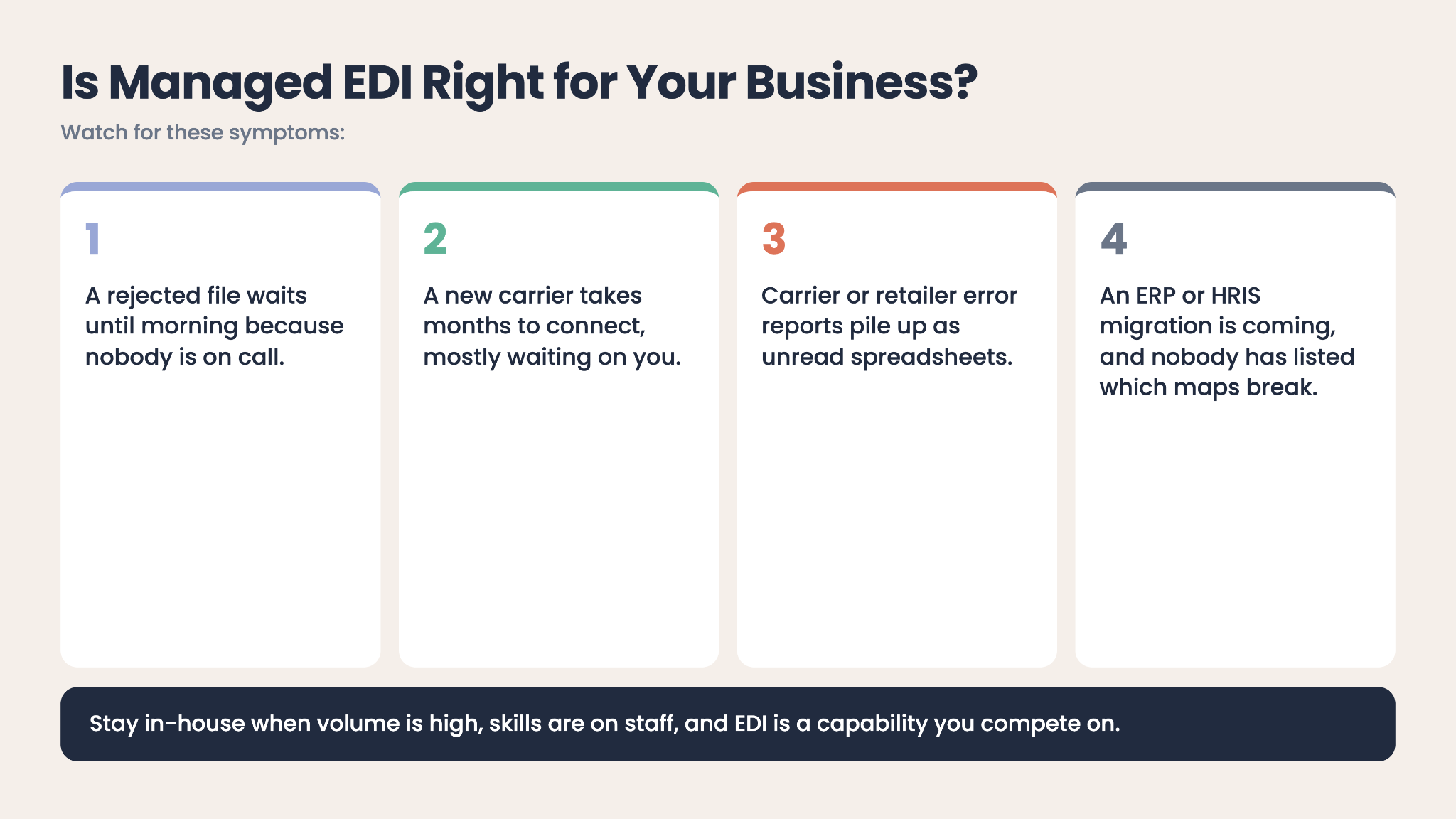
Is Managed EDI Right for Your Business?
Four signs point to outside help.
Failed files sit overnight with no one on call, and a carrier feed needs months to go live, mostly because of delays on your end. Carrier error reports stack up unopened, and nobody has checked which maps an upcoming ERP or HRIS migration will break.
Keep EDI in-house if you run high volume, employ EDI specialists, and treat EDI as a competitive edge.
Key Takeaways for Business Owners
A provider runs EDI operations while you keep carrier relationships and decisions.
Judge providers by artifacts: maps, acknowledgments, error reports and SLAs.
Four pricing models exist, and fee traps hide outside the headline price.
Ask which source systems and carrier connections the provider supports today.
Next, list every connection and the hours spent on failures last quarter.
FAQ
Frequently asked questions
What are managed EDI services?
Managed EDI services are an arrangement in which a provider builds, runs and monitors your Electronic Data Interchange connections: mapping, connectivity, carrier onboarding, acknowledgments and error resolution. You keep carrier relationships and business decisions, and the provider answers to an SLA.
What are the benefits of managed EDI services?
Benefits include lower operational overhead, faster carrier onboarding from a library of tested maps, same-day error triage under an SLA, and continuity when your only EDI analyst leaves. Costs become a predictable monthly line, and a dashboard shows which files arrived.
Is an EDI managed service suitable for small businesses?
Yes, when a small business must meet a carrier's 834 or other EDI requirement without EDI staff. Per-connection or tiered pricing keeps entry costs low, and an EDI managed service replaces a hire the small business cannot justify.
When should a company outsource EDI?
Outsource EDI when carrier error reports or invoices expose failures before your team does, when new connections take months, when one person knows the maps, or before an ERP or HRIS migration. An EDI managed service provider costs less than the errors you absorb.
Can an EDI managed service integrate with an HRIS or ERP?
Yes. The provider connects to your HRIS or ERP through a named connector, an API, or a flat-file export over SFTP, then maps it into the transaction set each carrier expects. Ask which connectors are live today for your system, not planned.
Benefits Open Enrollment: Employer Guide and Checklist
A complete open enrollment guide for employers: when the open enrollment period runs, key dates and deadlines, a step-by-step checklist, and tips that work.
Best HRIS Systems: Top 10 Picks by HR Teams in 2026
Discover the best HRIS systems in 2026. Compare the top 10 HRIS platforms, features, pricing, pros and cons, and find the best HRIS software for your HR team