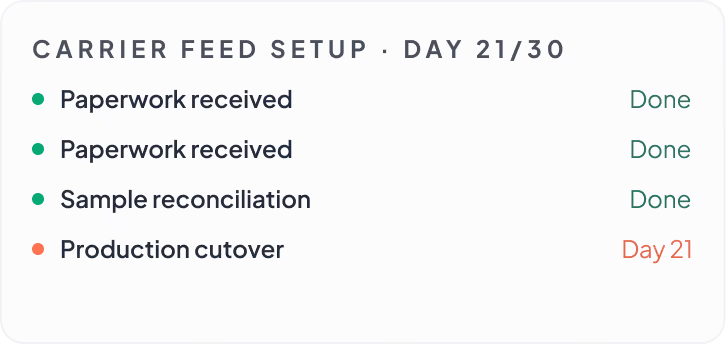
Reconciliation typically goes live in weeks. EDI feeds go live in 30 days per carrier — compared to the 6-month industry norm.
RECONCILE BENEFITS FASTER. LAUNCH EDI IN 30 DAYS.
Tabulera is the enterprise HR software that automates benefits reconciliation and EDI connectivity for large employers -- fully insured, self-funded, or both.
Reconciliation and EDI for teams that outgrew spreadsheets


When you're managing benefits for thousands of employees across multiple HRIS systems, payroll cycles, and carriers, manual reconciliation and slow EDI implementations stop being inefficiencies -- they become liabilities.
Managing benefits across thousands of employees, multiple HRIS systems, and dozens of carriers turns manual reconciliation and slow EDI into real liabilities.
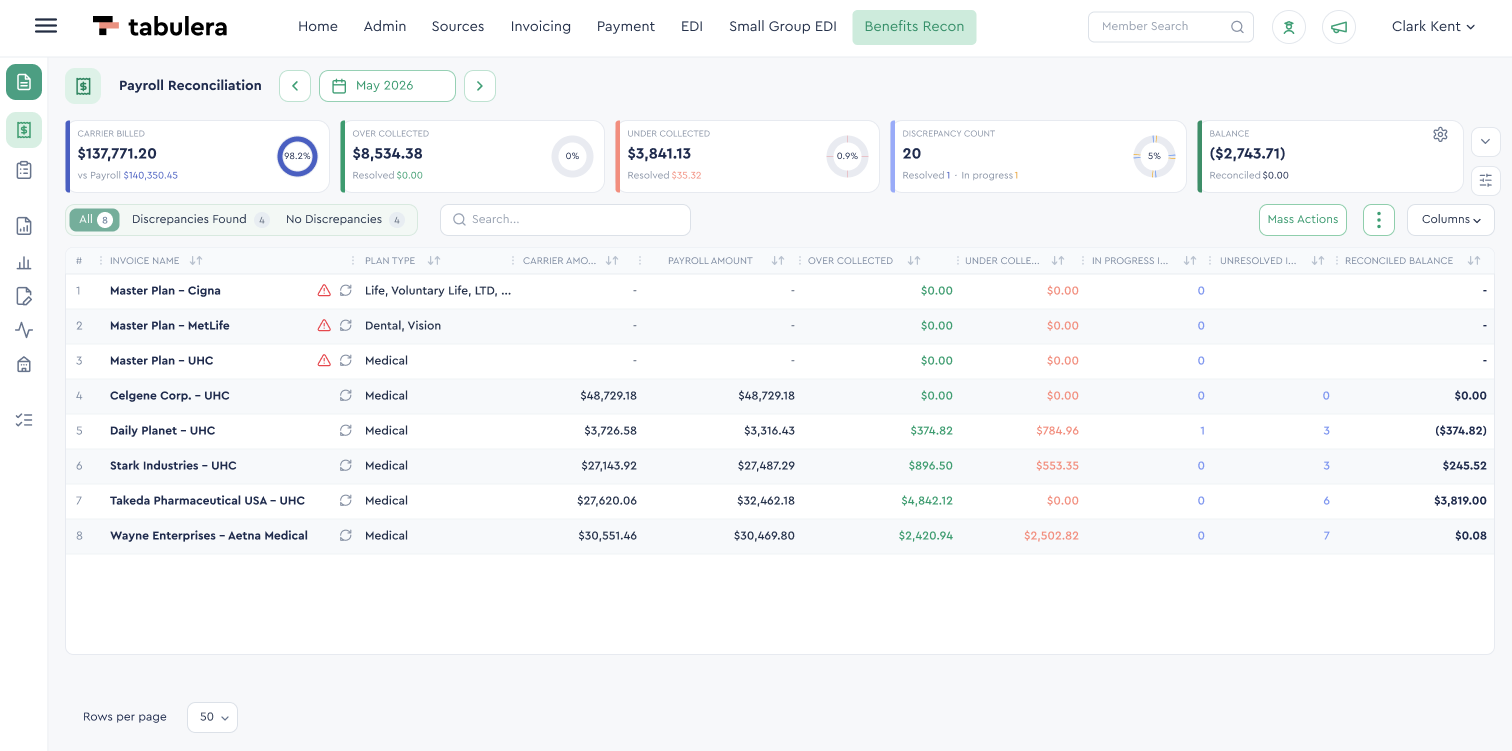
Tabulera does two things: reconciles your carrier invoices against payroll and enrollment, and gets EDI 834 carrier feeds live in 30 days.
Reconciliation runs against any list-bill or self-bill invoice. EDI 834 connectivity works with any HRIS, payroll, and TPA configuration.
Most enterprise HR software stops where benefits get expensive.
Front of the human resources lifecycle
Recruiting
Onboarding
Enrollment
Performance management
Time & attendance
Back of the human resources lifecycle
Carriers billing accurately
Claims paid for the right people
Employee data clean across every system
EDI feeds running without drift


Clean and repeatable monthly process
We unify enrollment, payroll, and carrier data, run automated Benefits Reconciliation against every invoice, and manage your EDI 834 feeds end to end - so benefits, finance, and IT all work from the same source of truth.

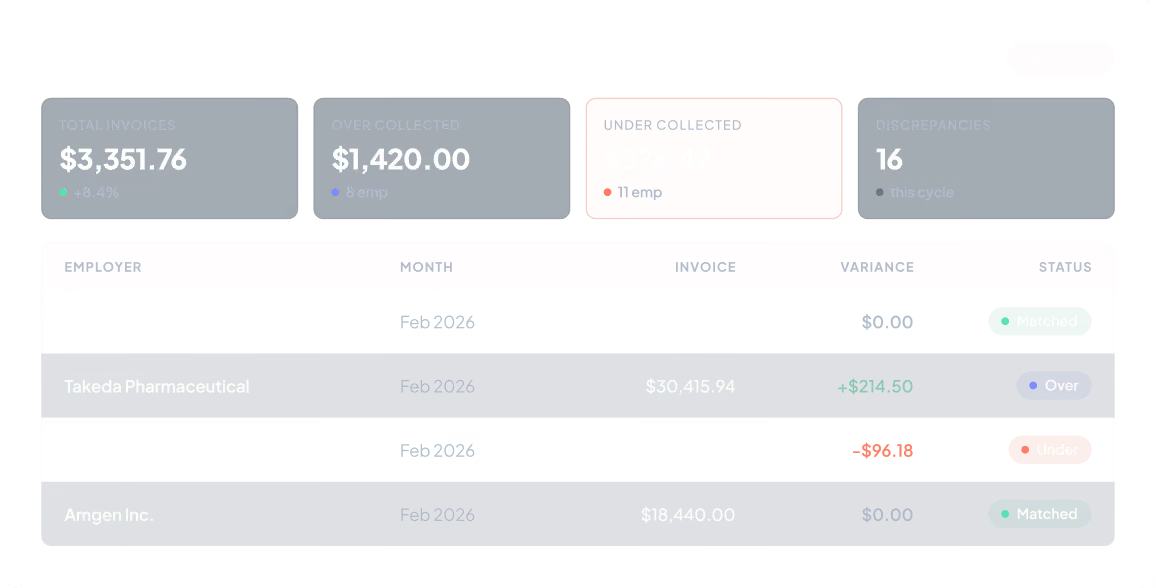
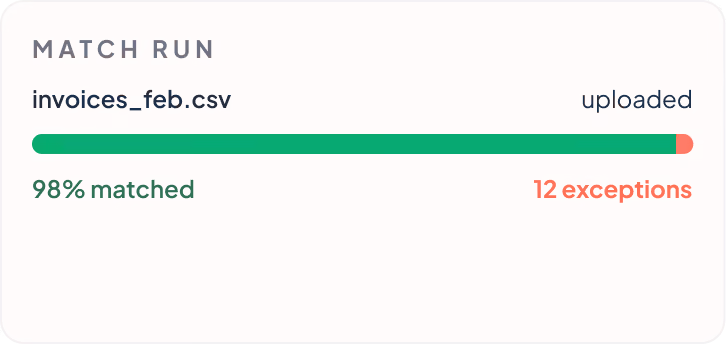
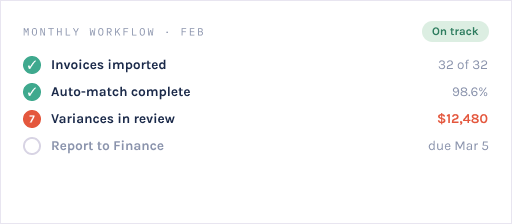
Each month, Tabulera runs your full reconciliation cycle -- start to finish -- with humans only touching variances that need a decision.
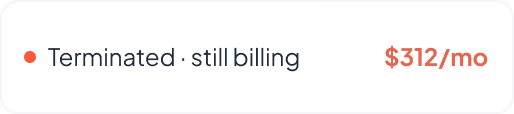
You're reconciling the carrier's monthly invoice -- list-bill or self-bill -- against payroll and enrollment. Catch variances inside the 60–90 day carrier window and they're recoverable.
There's no premium invoice to match. Tabulera reconciles HRIS, TPA, and stop-loss -- drift means claims paid for the wrong people, denied for the right ones.

Our team handles carrier coordination, file specs, validation, and testing while your team stays focused on benefits operations.
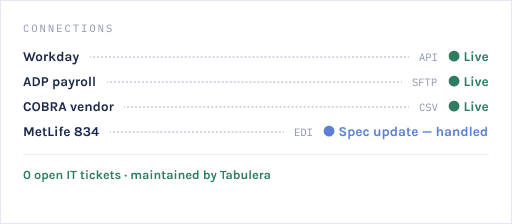
Carrier specs update, plans get added, HRIS exports evolve — the feed adapts so billing stays right and claims pay the right people.
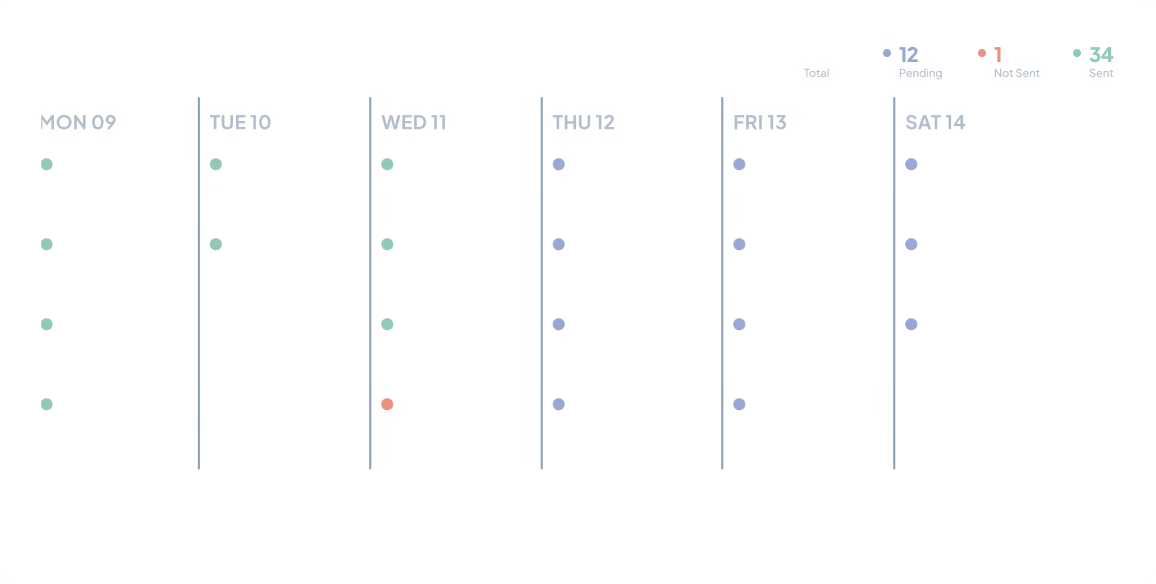
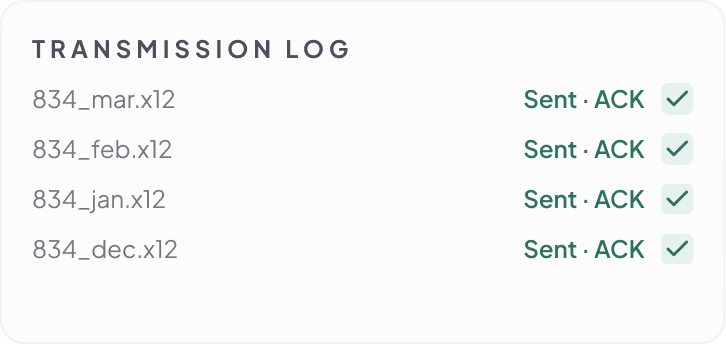
We monitor every transmission, validate before send, and flag exceptions before they become claims problems.
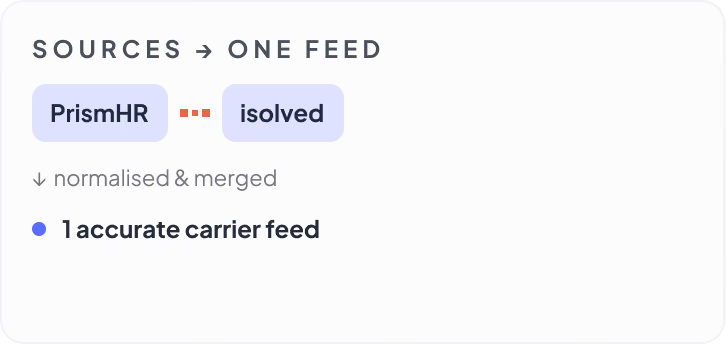
We accept any data format from any HRIS and normalize on our side — no internal IT lift required to add a new feed.
75%
Faster reconciliation
than manual processes
30Days
EDI go-live vs.
the 6-month industry norm
0%
EDI client churn
in 10 years
SOC
SOC I,
Type II certified
We unify enrollment, payroll, and carrier data, run automated Benefits Reconciliation against every invoice, and manage your EDI 834 feeds end to end - so benefits, finance, and IT all work from the same source of truth.
Enterprise HR solutions need to handle both ends of the benefits lifecycle -- sending accurate enrollment to carriers, and verifying that what comes back matches what was sent.
Fully Insured Plans
List-bill carriers send what they think you owe, and self-bill setups depend on rate tables and plan configurations staying in sync. Our HR enterprise software catches errors on a repeatable monthly workflow -- not in a fragile spreadsheet maintained by one person.
Self-Funded Plans
When you self-fund, enrollment errors show up as paid claims for the wrong people, or denied claims for the right people. Tabulera reconciles HRIS, TPA, and stop-loss data on a monthly cycle so gaps surface before the claim does.
Carrier Connectivity
Large employers run multiple HRIS systems -- sometimes one per business unit or acquired entity. Tabulera merges feeds across systems, normalizes employee data, and delivers one validated 834 to each carrier.
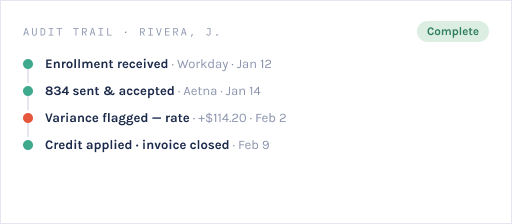
Audit trail
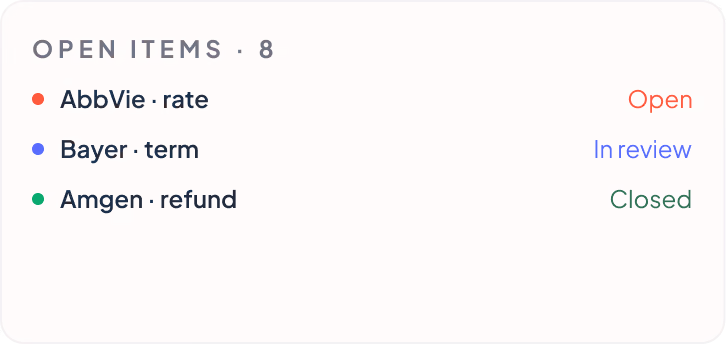
Every variance, adjustment, and resolution is logged with a full audit trail. Auditors get the documentation they need -- global compliance reporting becomes a query, not a fire drill.
Reconciliation and EDI sit at the intersection of human resources and finance -- exactly where most HR software stops. Tabulera serves all three teams that touch benefits data, with one platform supporting HR processes from enrollment through invoice close.
for
Eliminate the administrative chaos that lives inside Excel -- no disconnected spreadsheets, accurate forecasts to finance and complete audit trails.
for
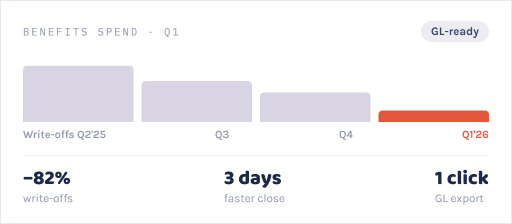
Take control of benefits spend -- no year-end write-offs, faster close, and clean reporting and analytics ready for the GL.
for
Move benefits data off the IT plate -- any HRIS works, any data format works, and no custom file specs to fix every time a carrier makes changes.
Tabulera connects directly with Workday, ADP, UKG, PrismHR, isolved, Employee Navigator, and any other HRIS through reports, flat files, APIs, or SFTP.
We accept any data format and normalize it on our side — so your HR processes don't have to bend to match ours.
Move benefits data off the IT plate -- any HRIS works, any data format works, and no custom file specs to fix every time a carrier makes changes.


See how ZampHR (Engage PEO Company) streamlined benefits reconciliation for 13,000 employees, reconciling 130 monthly carrier invoices.


See how an ASO organization managing benefits for 7,000 employees eliminated benefits write-offs by streamlining the reconciliation process.
Reconciliation typically goes live in weeks. EDI feeds go live in 30 days per carrier — compared to the 6-month industry norm.
Yes. Self-funded reconciliation is a fundamentally different problem than fully insured — we match enrollment across HRIS, TPA roster, and stop-loss file rather than against a premium bill.
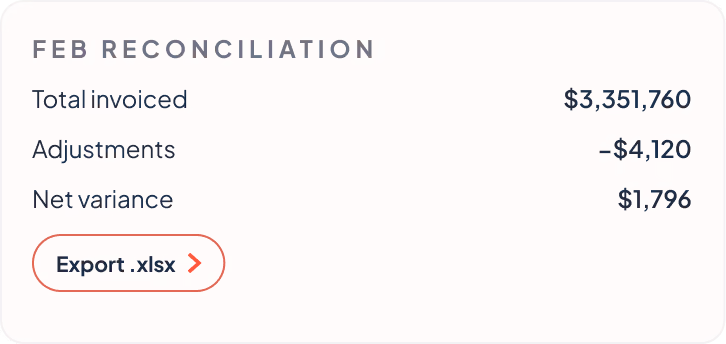
Tabulera's HR enterprise software exports reconciliation results, invoice summaries, and variance reports in formats your human resources and finance teams can drop straight into the GL — Excel, CSV, or system-specific outputs.
Clean EDI 834 feeds mean carriers have accurate enrollment data, employees actually have coverage when they need care, and your benefits team isn't fielding access-issue calls. Bad EDI feeds produce the opposite: inaccurate billing and, on self-funded plans, claims paid or denied for the wrong people.
For fully insured plans, undetected billing errors typically run 1–2% of premium spend. For self-funded plans, exposure is bigger — claims are paid directly, and stop-loss carriers can deny claims for members whose enrollment was never properly established.
Two specific problems for large employers: benefits reconciliation (matching carrier invoices to payroll and enrollment data) and EDI connectivity (getting 834 feeds live and keeping them clean). Both are usually handled by spreadsheets and manual coordination at the enterprise level — and both are where money quietly leaks out.