Benefits Open Enrollment: Employer Guide and Checklist
A complete open enrollment guide for employers: when the open enrollment period runs, key dates and deadlines, a step-by-step checklist, and tips that work.
Open enrollment ends with the first January invoice, not the close date.
Go active when plans, contributions, or dependent data change; passive when everything is stable.
Check every submission the day it lands; it’s cheaper than a carrier rejection in December.
Schedule the January invoice reconciliation before the window opens; first invoices rarely match.
What is benefits open enrollment?
Eligible employees get one window a year to elect, change or waive employer-sponsored benefits for the coming plan year; once it closes, elections stay fixed until the next window unless a qualifying event occurs. When a new manager asks what is open enrollment for benefits, that is the answer: the one time an employee can switch health plans, add dependents or reset pre-tax contributions without a life event.
Why the annual open enrollment period happens every year
Three rules make open enrollment annual. Section 125 cafeteria plan rules, which let employees pay premiums and fund flexible spending accounts (FSAs) pre-tax, require elections before the plan year starts and hold them irrevocable except for permitted changes. Carrier contracts and rates renew once a year. And plan design and contribution decisions, which health plans you offer and how much premium you pay, are set per plan year, so employees need one window to respond.
Active vs. passive enrollment
Open enrollment for benefits runs one of two ways. In an active open enrollment, every eligible employee must elect or be defaulted, usually to waived coverage. In a passive one, elections roll forward unless changed.
Some elections never roll: health and dependent care FSA elections, usually Health Savings Account (HSA) payroll contributions, and supplemental life increases above the guaranteed issue amount, which need evidence of insurability.
Go active when the lineup of health plans, contribution strategy or dependent data changes; go passive when everything is stable and the data is clean.
When is the open enrollment period? Key dates for employers
Most employer health plans run a two- to four-week open enrollment window between late September and mid-November for coverage effective January 1, 2027; non-calendar plans run their own schedule. Say your window runs Monday, October 5, 2026 through Friday, October 23, 2026. This open enrollment guide builds its dates from it.
Key open enrollment dates to put on your calendar
Calendar-year plan, fall 2026 season:
Date or window
What it is
Who it affects
What HR does
Before October 15, 2026
Part D creditable coverage notice
Medicare-eligible individuals
Send; keep pro… [?]
October 15 to December 7, 2026
Medicare Annual Enrollment Period
Employees, spouses 65+
Explain plan coordination
November 1, 2026 to January 15, 2027
Affordable Care Act (ACA) Marketplace (HealthCare.gov); December 15 for January 1 coverage
Part-time, ineligible, waiving employees
Refer; state exchanges vary
October 5 to 23, 2026 (example)
Your enrollment window
Benefits-eligible employees
Track completion; freeze at close
Typically December 1 to 15 (confirm per carrier)
Carrier file deadline, two to four weeks before effective date
Every carrier and feed
Send files; pull confirmation reports
First 2027 pay date
First payroll with new deductions
Everyone enrolled
Verify deduction codes first
January 1, 2027
Coverage effective
Everyone enrolled
Confirm eligibility at each carrier
Early January 2027
First carrier invoices
Benefits, finance
Audit every line against enrollment
March 2, 2027 (expected; confirm in the 2026)
Form 1095-C furnishing deadline, 2026 tax year
Full-time employees
Furnish or post the request notice
Employer-sponsored plan timelines
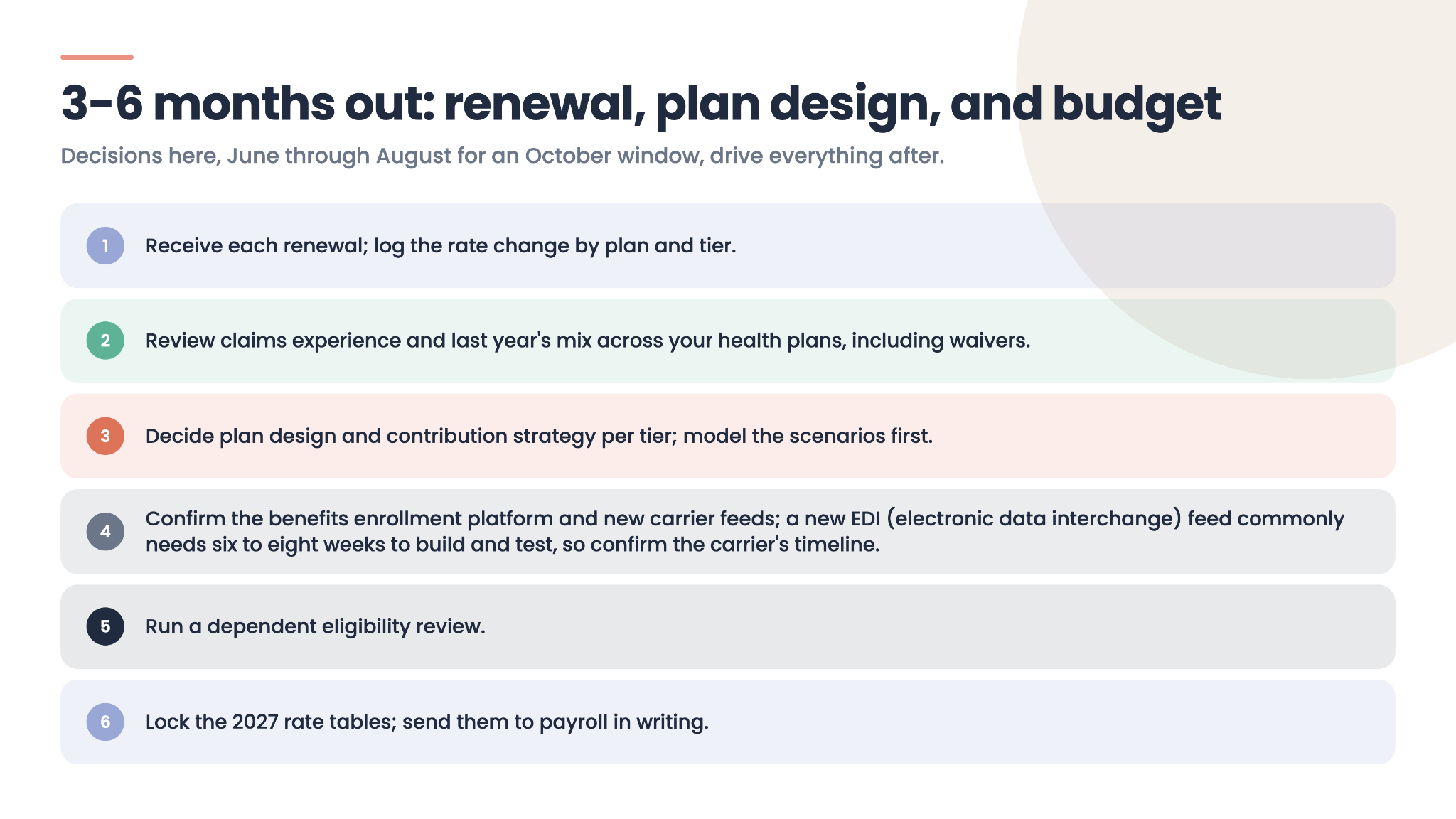
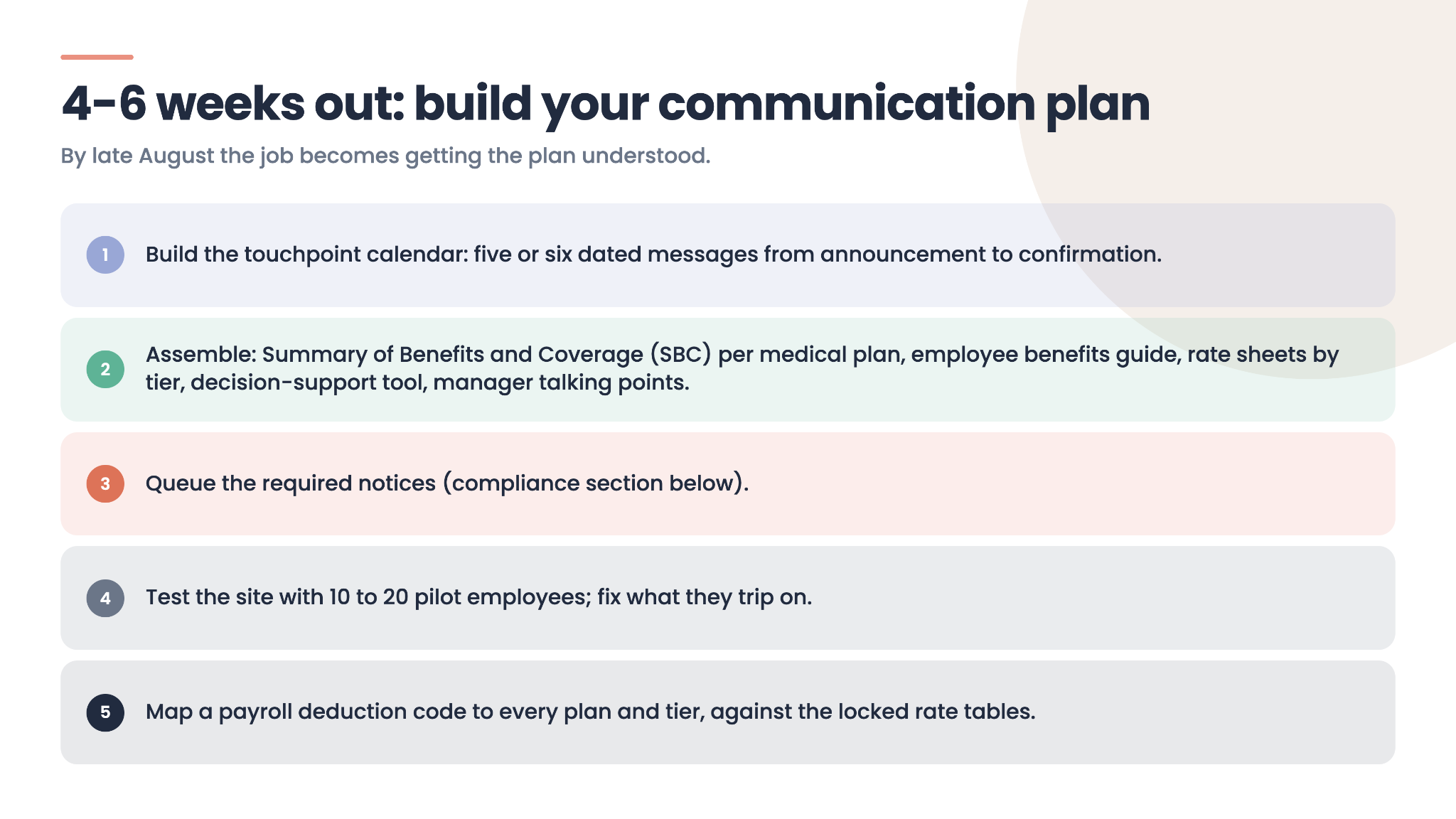
Back-time from day one of open enrollment. For the October 5 window, renewals arrive 90 to 120 days out (June to early July 2026); plan design, contribution strategy and rate tables for your health plans are decided 60 to 90 days out (by early August); communications start four to six weeks out; the window runs two to three weeks. After October 23, elections freeze, files go to carriers in November, deductions load before the first January payroll, and first invoices are audited in January 2027.
You do not run these windows, but they land on your desk. Part-time and ineligible employees ask where to buy health insurance; point them to the Marketplace. Employees with Medicare-eligible spouses ask how the plans coordinate, and the Part D notice covers creditable drug coverage. Medicaid and CHIP (the Children's Health Insurance Program) enroll year-round. The employer mandate: offer coverage to at least 95% of full-time employees, with one option under the Affordable Care Act affordability threshold, 10.22% of household income for 2027.
Special enrollment periods
Outside the open enrollment period, a recognized life event opens a Special Enrollment Period: 30 days for most events, such as loss of other health insurance, marriage, birth and adoption, and 60 for loss of Medicaid or CHIP coverage or new CHIP premium assistance. The change must be consistent with the event.
Employee benefits open enrollment: what your team can choose
This article is about what you run, but employees judge open enrollment benefits by the choices in front of them. Four groups cover most enrollment sites.
Medical, dental, and vision
Medical is the health insurance election that drives cost. Most large employers offer two or three health plans: a PPO (preferred provider organization) with a broad network and higher premiums; an HMO (health maintenance organization) with a narrower network and lower premiums; and an HDHP (high-deductible health plan) paired with Health Savings Accounts. Employees compare three numbers: per-paycheck premium, deductible and out-of-pocket maximum; the last two set the out-of-pocket costs of a bad year. Dental and vision are separate elections with their own tiers.
Life and disability insurance
Basic life is usually employer-paid at one or two times salary. Supplemental life is employee-paid, and open enrollment is often the one time an employee can increase it up to the guaranteed issue amount without evidence of insurability; above it, a health questionnaire applies. Voluntary short- and long-term disability work the same way.
FSAs, HSAs, and HRAs
Health Savings Accounts require a qualifying HDHP. For 2027: contribution limit $4,500 self-only and $9,000 family, HDHP minimum deductible $1,750 and $3,500, out-of-pocket maximum $8,700 and $17,400 Rev. Proc. 2026-24. Health FSA elections do not roll over; the 2026 limit is $3,400 with a $680 carryover, the dependent care FSA limit is $7,500, and the 2027 figure should be confirmed in the Internal Revenue Service (IRS) release. HRAs (health reimbursement arrangements) are employer-funded and employer-designed. Health Savings Accounts, by contrast, belong to the employee, cover out-of-pocket costs pre-tax and can change any month.
Retirement and voluntary benefits
Retirement plans run on their own rules; 401(k) deferrals can change any time, though many employers bundle a review into the same communications. Voluntary lines are elected during open enrollment: critical illness, accident, hospital indemnity, legal, pet and identity protection. Health and well-being benefits, such as an employee assistance program (EAP) or wellness stipend, need no election; remind people they exist.
Open enrollment checklist for employers
The benefits open enrollment process has four phases, each with a checklist below. Every item names an artifact it produces or checks; "communicate with employees" is not a task.
By early August, three things should be true: every renewal is logged by plan and tier, the mix across your health plans has been modeled, and the benefits enrollment platform has a tested EDI (electronic data interchange) feed to each carrier. Multi-client teams should expect the same checklist per client, which is what benefits administration software for service providers is built to hold.
Nothing goes out that a manager cannot repeat. The employee benefits guide, rate sheets and talking points should answer the three questions every employee asks: what changed, what it costs per paycheck, and what happens if they do nothing.
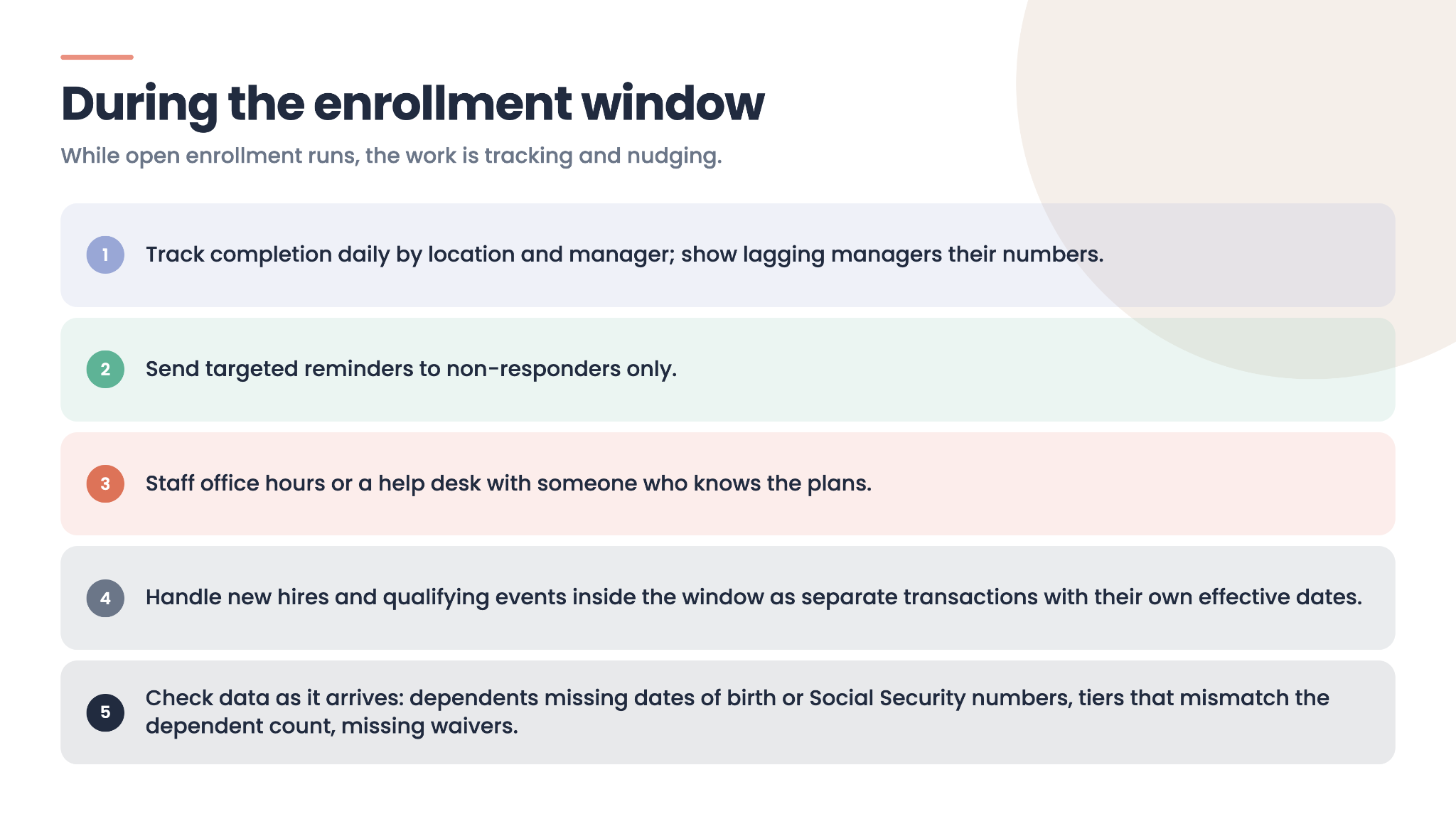
Three weeks of open enrollment come down to two habits: a daily completion count that managers see, and a data check on every submission the day it lands. Both are cheaper now than as carrier rejections in December.
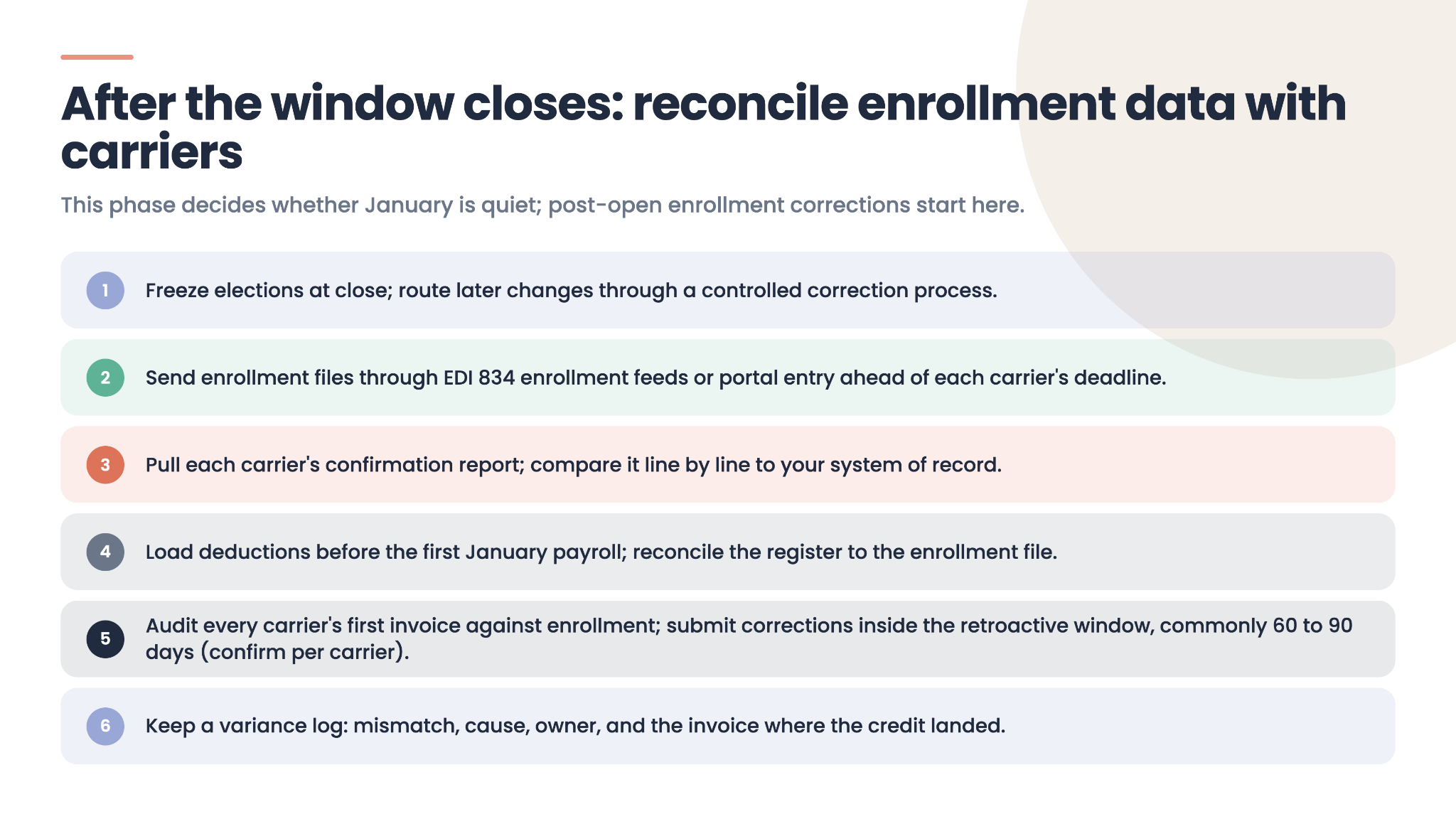
Elections become files, files become confirmation reports, and confirmation reports become the first invoice; a mismatch caught at any earlier step is a post-open enrollment correction you never have to make. Send through EDI 834 enrollment feeds where a carrier offers them, and keep one variance log per carrier, and per client if you serve several.
Open enrollment tips for employers
Deadlines get announced every year. This open enrollment guide adds four habits that separate a window that runs itself from one that runs you.
Build your employee open enrollment communication plan
For the example window, a six-touch cadence:
Monday, September 21: announcement from the head of HR with what changed and the dates.
Tuesday, September 29: education session, live and recorded.
Monday, October 5: day-one email with the link, plus manager talking points.
Wednesday, October 14: reminder to non-responders, sent by their manager.
Tuesday, October 20: last call by email and text, three days before close.
Week of October 26: confirmation statements showing elections and per-paycheck deductions.
Email carries facts; managers carry urgency; the confirmation statement catches errors before the carrier file does.
Educate employees, don't just announce deadlines
The lowest premium is not always the lowest total cost. As an illustration, take two health plans: a PPO at a $200 monthly employee premium, $750 deductible and $3,000 out-of-pocket maximum, and an HDHP at $110, with a $2,000 deductible, $6,000 maximum and $600 employer contribution to Health Savings Accounts. With $400 of care, the HDHP costs $1,120 against $2,800 for the PPO. At the maximum, the PPO costs $5,400 and the HDHP $6,720, because out-of-pocket costs outrun the premium savings. Show both years, with out-of-pocket costs included.
Stay ahead of required notices and compliance
Notices travel with open enrollment; send them with the materials; log the date. The Affordable Care Act requires a Summary of Benefits and Coverage for each of your health plans. The Medicare Part D creditable coverage notice goes to Medicare-eligible individuals before October 15, per the Centers for Medicare & Medicaid Services. Add the CHIP notice, Women's Health and Cancer Rights Act (WHCRA) notice, HIPAA (Health Insurance Portability and Accountability Act) special enrollment notice, and a Summary of Material Modifications (SMM) for plan changes. This is context, not legal advice.
Use last year's enrollment data to plan this year's
Pull six numbers from the 2026 plan year before setting this year's open enrollment plan: election mix across your health plans (cost-model baseline), waiver rate (who goes to the Marketplace or a spouse's plan), midpoint non-response rate (reminder cadence), the day the surge hit (help desk staffing), post-enrollment correction count (active or passive), and first-invoice variances by carrier (which feed to test first).
Open enrollment strategies to control cost and admin work
Cost and admin work in open enrollment come from the same place: data that changes hands too often. Each strategy below has a checkable mechanic.
Open enrollment period strategies that reduce errors
Treat the open enrollment process as a data project with one system of record. Validate at entry: required fields, dependent Social Security number and birth date, tier matched to dependent count. Set a hard freeze date, lock payroll rate tables, send a test EDI file to each carrier before the production file, and reconcile confirmation reports before the first invoice. Those controls catch the five errors that otherwise reach the invoice: wrong coverage tier, missing dependent, duplicate record from manual portal entry alongside a feed, wrong effective date, and a waived employee still enrolled.
Model plan costs before you commit
As an illustration, take 800 enrolled employees, employer-paid premium averaging $850 a month on the PPO and $700 on the HDHP, and a $50 monthly employer contribution to Health Savings Accounts. At a 70/30 mix, employer cost is $656,000 a month. Shift 10 points to the HDHP: premium falls 80 × $150 = $12,000, the HSA contribution rises 80 × $50 = $4,000, net saving $8,000 a month, $96,000 a year. Raise the seed to $100 to offset the out-of-pocket costs the HDHP shifts to employees, and the same mix costs $8,000 a month more than baseline. Run all three on your health plans before signing: flat mix, the shift, and the shift plus its seed.
Put the January reconciliation on the calendar in September
What happens after open enrollment ends
A typical benefits enrollment guide stops at the close date. This one does not; the eight weeks after it decide whether January goes well.
No; open enrollment elections hold, with two exceptions. A qualifying event (marriage, birth, adoption, loss of other coverage) opens a Special Enrollment Period, and the change must be consistent with the event. Section 125 otherwise holds pre-tax elections for the plan year. Two things sit outside that rule: contributions to Health Savings Accounts, which cover out-of-pocket costs and can change any month, and 401(k) deferrals. Put both in the FAQ you publish.
What to do when an employee misses the open enrollment deadline
By design, a passive year rolls last year's elections forward and an active year defaults the employee to waived coverage or the default medical plan. Some carriers allow a short late-enrollment grace period, often a few days to two weeks after close; confirm per carrier and write it down before the open enrollment period opens. Otherwise the employee waits for the next recognized life event or window, with the Affordable Care Act Marketplace as the health insurance fallback. Apply the policy the same way to everyone.
Why your first carrier invoices after enrollment often don't match
The first January invoice after open enrollment rarely matches, for specific reasons: processing lag on late files, retroactive adds and terminations, mid-month effective dates prorated inconsistently, tier changes whose dependent never reached the carrier, age-banded rates recalculated on January 1, duplicates from portal entry beside a feed, waived employees still billed, and COBRA (Consolidated Omnibus Budget Reconciliation Act) participants mixed into the active invoice.
The fix: compare each invoice line to the enrollment record for that person and month, categorize the variances, submit corrections inside the retro window, and track the credit on the next invoice. This is the post-open enrollment work most teams still do in Excel at night.
See how Tabulera automates benefits premium administration
Tabulera's benefits reconciliation software matches carrier invoices to enrollment and payroll data every month, flags premium variances by person and line, and manages carrier connections. It is built for employers with 500 or more employees, for benefits administration outsourcers such as PEOs, ASOs and TPAs, and for brokers. The team built it after years of doing this work by hand. Enrollment-season support is included: three months before your enrollment date, the team rebuilds the whole configuration for the new plan year, at no charge and without being asked. If the post-enrollment section above sounds like your January, see how it works and decide for yourself.
FAQ
Frequently asked questions
How long is the open enrollment period?
Most employer health plans run a window of two to four weeks, typically three at large employers. It usually falls between late September and mid-November for January 1 coverage; the Marketplace runs November 1 to January 15. Publish your dates two weeks before day one.
What happens if I do nothing during open enrollment?
If an employee does nothing, the outcome depends on the open enrollment type: in a passive year, health insurance and other elections roll forward; in an active year, they default to waived coverage or the default plan. FSA elections end either way. Announce which type you run.
Can you get around open enrollment?
Not by choice. Outside the window, the only way in is a Special Enrollment Period triggered by a qualifying life event: 30 days for most events, 60 for Medicaid or CHIP changes. Those who miss it can buy health insurance on the Marketplace. Publish the event list and deadlines.
Will I automatically re-enroll if I don't do open enrollment?
Only in a passive open enrollment, and only for elections that roll: medical, dental, vision and basic life carry forward, while FSA elections and usually HSA contributions stop on December 31. In an active enrollment nothing rolls. Say in every reminder which elections roll.
Can an employee change benefits after open enrollment ends?
Only after a life event the plan recognizes, in a change consistent with that event, within 30 days (60 for Medicaid and CHIP changes). Contributions to Health Savings Accounts and 401(k) deferrals can change any time. Document a mid-year change process; do not run it by email.
Benefits Open Enrollment: Employer Guide and Checklist
A complete open enrollment guide for employers: when the open enrollment period runs, key dates and deadlines, a step-by-step checklist, and tips that work.
Best HRIS Systems: Top 10 Picks by HR Teams in 2026
Discover the best HRIS systems in 2026. Compare the top 10 HRIS platforms, features, pricing, pros and cons, and find the best HRIS software for your HR team