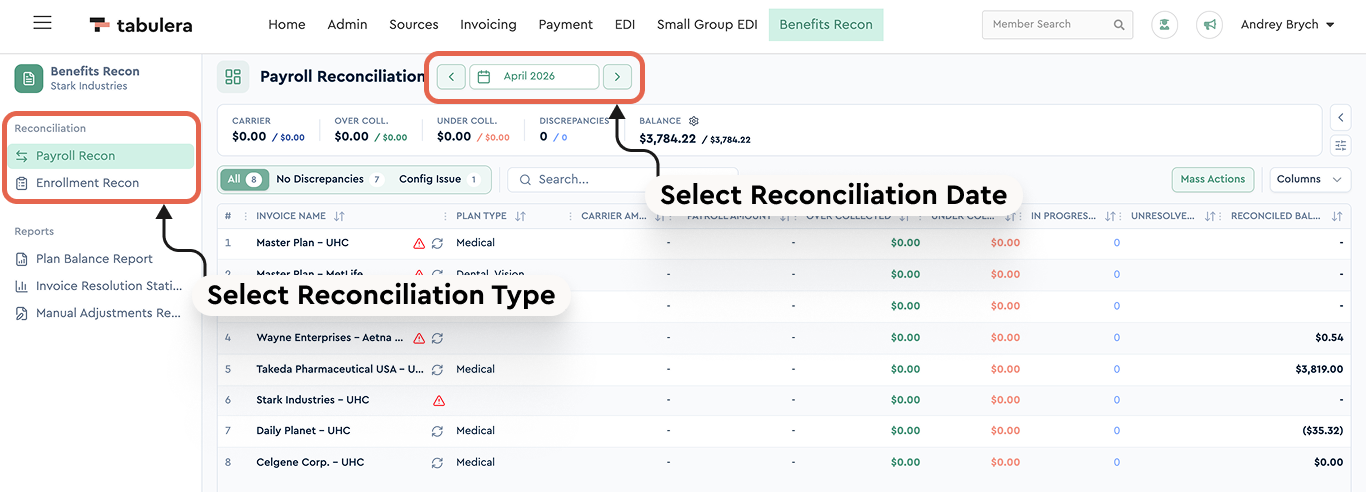
At the top of the workspace you'll find the reconciliation type and period selector.
As before, there are two reconciliation types:
1. Payroll reconciliation — matching payroll deductions and COBRA against carrier invoices.
2. Enrollment reconciliation — matching enrollment and COBRA records against carrier invoices.
To switch between them, click the reconciliation type in the left menu. The menu opens in two ways: click the vertical divider line, or use the hamburger button at the top. Then select the reconciliation period you're working on.
A statistics panel you can shape to your workflow
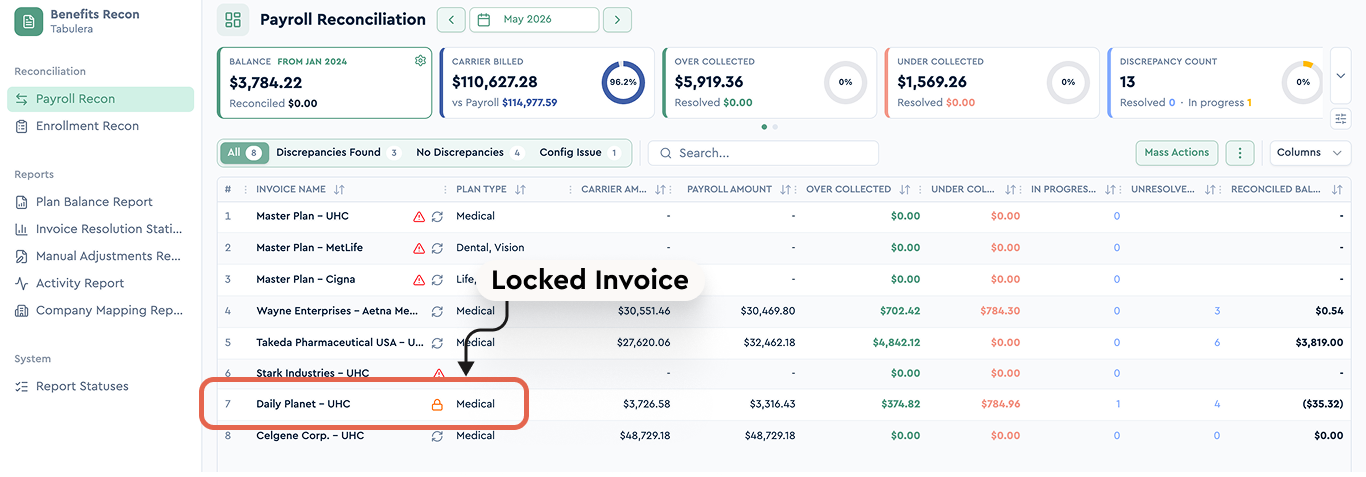
The statistical panel beneath the selector has been completely redesigned — and it's now customizable. You can enable the sections that matter to your process and rearrange them by dragging the column headers into the order you prefer.
[[Tip]]What this means for you: the numbers you check first — total variances, resolution progress, balances — can now sit exactly where you look first. The panel reflects your workflow instead of dictating it.[[/Tip]]
The invoice list, reworked
The invoice list is where reconciliation starts, and it has been rebuilt around a simple idea: the list should tell you where the problems are before you open anything.
The view is now divided into sections that let you filter invoices instantly:
invoices with unresolved variances
invoices that are clean
invoices with configuration issues such as incomplete mapping.
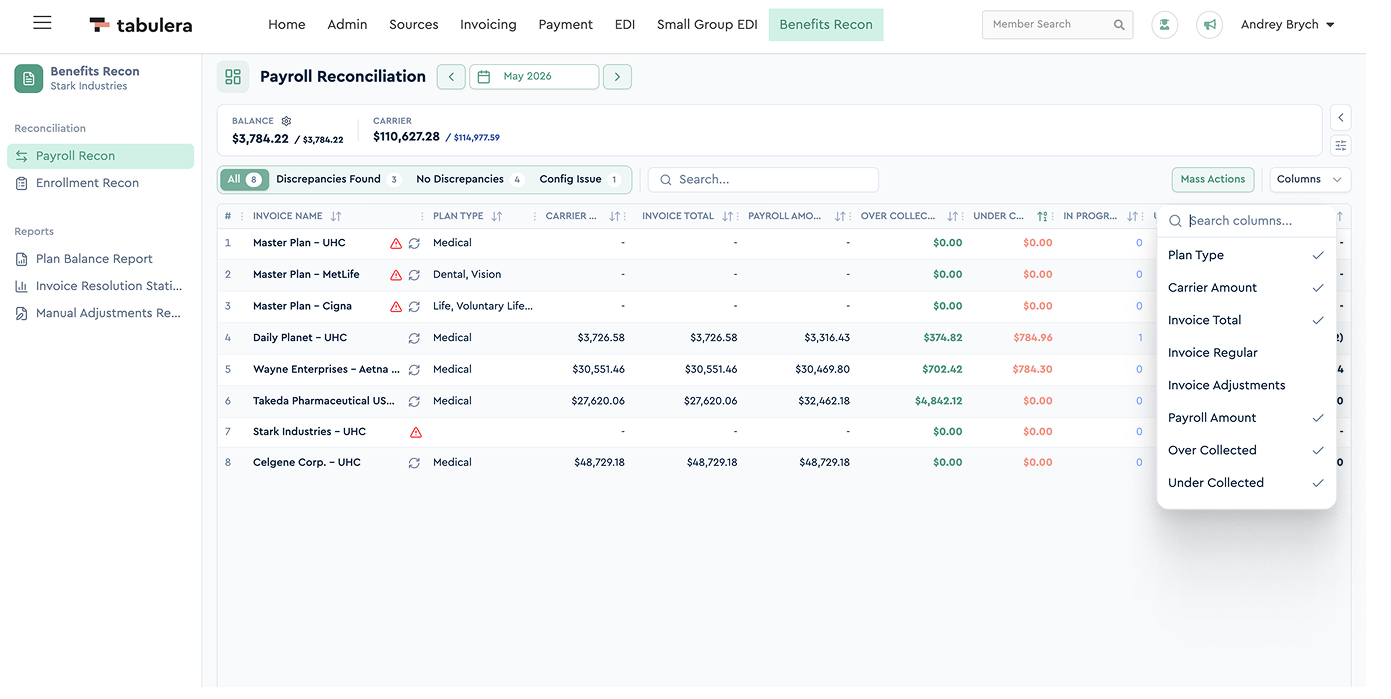
The column view is now fully customizable. Pick your columns from the columns dropdown, sort by any of them, and filter directly from the column header.
Locking a finalized reconciliation
If an administrator has locked an invoice, a lock icon appears next to its name. Locking closes a reconciliation period for editing.
Use it once every discrepancy on the invoice has been reviewed and resolved. Open the invoice, complete the reconciliation, click the lock icon next to the invoice name, and confirm. From that point, the lock indicator tells everyone on the team that this period is closed.
[[Tip]]A finished month stays finished. Nobody can accidentally refresh, adjust, or overwrite reconciliation results your team has already signed off on.[[/Tip]]
[[Tip]]On the first screen of your session, you already know which invoices need attention, which are done, and which are waiting on configuration — no opening invoices one by one to find out.[[/Tip]]
Status indicators on every invoice
As before, the invoice name column carries status indicators and quick actions.
The refresh button regenerates the reconciliation view after new data has been uploaded. The gear icon means the invoice mapping hasn't been configured yet — clicking it launches the mapping wizard. And when a warning icon appears, hover over it to see the reason, so you know what needs fixing before you open the invoice.
The mapping wizard, reworked
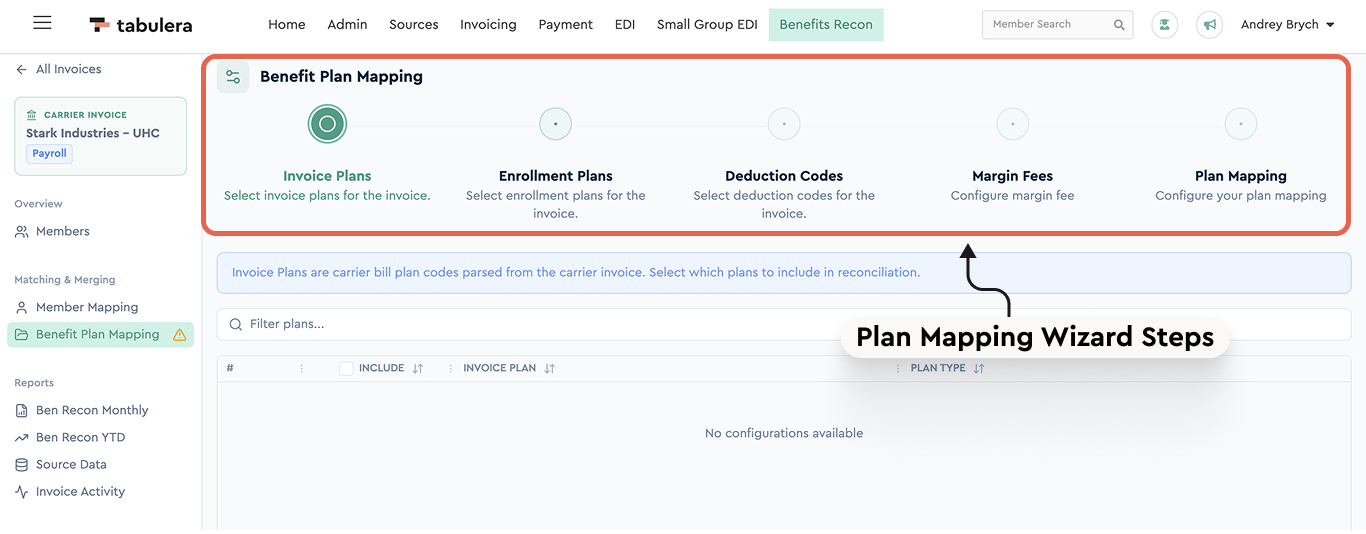
Mapping is how the platform learns to read your invoices, and the wizard that configures it has been rebuilt. It joins two menus of the invoice view — Plan Configuration and Plan Mapping — into a single five-step flow, so a new invoice goes from raw plan codes to a working reconciliation in one pass. Plan Configuration - let's you choose the plans that you with to include in the reconciliation.
Margin fees
Margin fees is a for companies whose enrollment or payroll amounts include a margin or administrative fee, while the carrier's bill doesn't. Without an adjustment, every one of those records would show up as variance.
[[Tip]]Mid-year fee changes no longer require workarounds or manual corrections — the platform applies the right rate to the right months automatically.[[/Tip]]
Plan mapping
Plan mapping is where you tell the platform which enrollment plans and payroll deduction codes relate to which invoice plan, with a status of mapped, partial, or unmapped next to every row. This is the configuration your entire reconciliation runs on.
Everything stays editable after the wizard
Nothing set in the wizard is final. Inside the invoice view, its steps live in two left-menu entries:
Plan Configuration holds the first four steps — invoice plans, enrollment plans, deduction codes, and margin fees — and Benefit Plan Mapping holds the mapping itself.
Open Benefit Plan Mapping at any time to see every mapped, unmapped, and partially mapped plan; the Plan Configuration button reopens the setup, and the Merge Plans button combines plans into one, exactly as in the wizard.
[[Tip]]When a carrier renames a plan mid-year or a new deduction code appears, the fix is a two-minute edit — not a reconfiguration.[[/Tip]]
Company-wide reports
The Reports section in the left menu covers reporting across all invoices, and it keeps growing. Recent additions include four new traceability columns in the Plan Balance Report — invoice number, enrollment plan ID, pre-pay flag, and lock status — plus a Running Balance column that shows how each balance accumulates month over month. The YTD report can now include payroll and carrier bill margin fee columns as well.
Every report exports to Excel, ready for audits, accounting, finance reviews, plan validation, and leadership requests:
Report
What it gives you
Plan Balance Report
Total plan costs per employee over a selected period, broken down by carrier or company
Invoice Resolution Statistics
How accurately the platform matched employees — useful for validating plan configuration
Manual Adjustments Report
Every manual change to plan balances, for audit and finance reviews
Activity Report
Who did what and when, across the platform
[[Tip]]Whether the request comes from an auditor, a controller, or your CEO, the answer is an Excel export away — with the audit trail included. (Each invoice also carries its own reports — more on those below, where we step inside an invoice.)[[/Tip]]
The member view: reconciliation, employee by employee
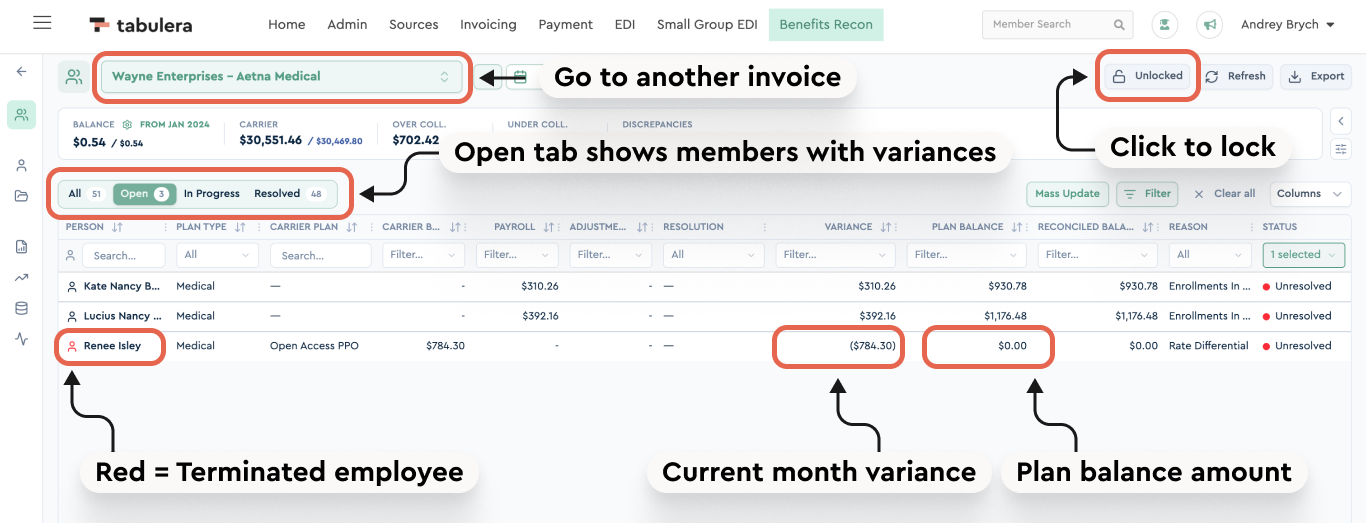
The reconciliation workflow itself hasn't changed: select an invoice from the list to open the Member View, the list of everyone on that invoice. The view around the workflow, however, has been reworked end to end.
Use the shortcut tabs to get started.
The Open tab shows EEs with variances. In progress shows EEs with variances that you started explaining. Resolved - the once that have no variances or with explaind variances.
You can now change the month you're reconciling directly from this screen, or jump to a different invoice using the built-in search — no trips back to the main list.
The member table is fully updated with sorting and filters — click the filter button to enable them, and combine filters to build exactly the list you need.
riMass updates of employee records run from here as well. Select the members you want — individually, or with the header checkbox to take everyone on the page — and the Update button shows how many you've picked. From there you can apply notes, change resolution status, or set a color across all of them at once. Any member marked unresolved, manually resolved, or in progress can be included. One safeguard worth knowing: if you leave the notes field blank, existing notes stay untouched, so a bulk status change can't wipe the context your team already wrote.
[[Tip]]The Open tab instantly hands you the list to work on, and filters narrow it further from there. No building a work queue — it's already waiting when you open the invoice.[[/Tip]]
Finding the root cause
Select any employee with variance you want to investigate.
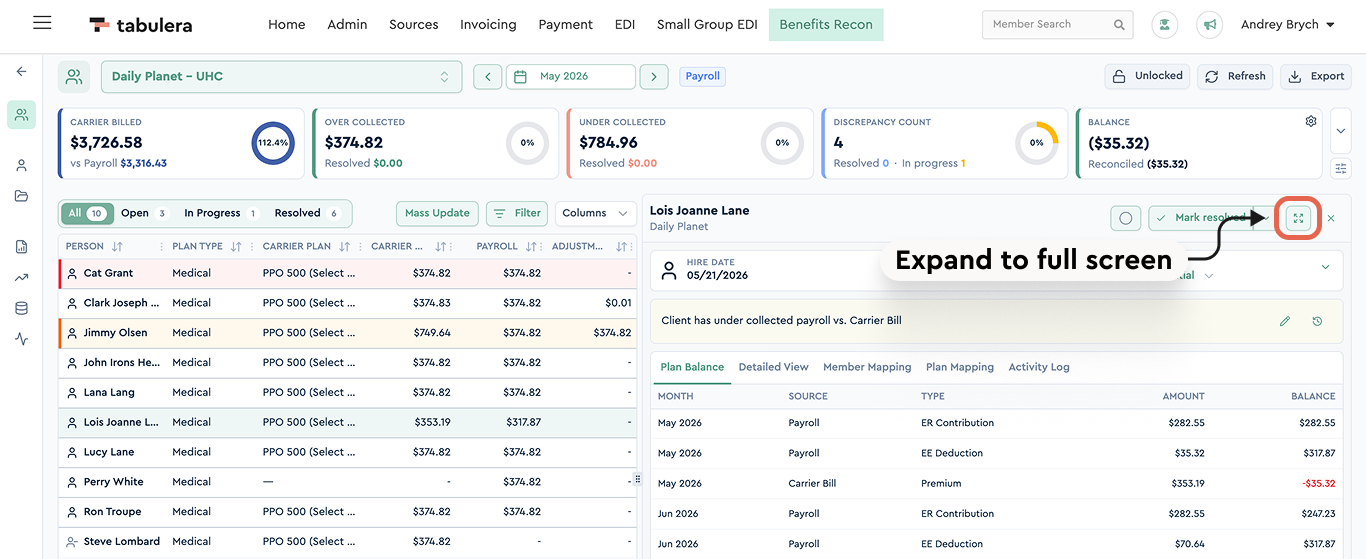
A familiar panel slides out on the right, holding everything about that person: the hire date and demographics, the variance reason in plain language, and tabs for plan balance, detailed view, member mapping, plan mapping, and the activity log. The plan balance itself is deductions plus contributions minus carrier premiums, which should come to zero every month. When it doesn't, the platform assigns the variance reason automatically — enrollments in transit, terminations in transit, rounding, or a configuration issue. Rows with no variance are marked auto-resolved without anyone touching them.
Here's what's new in that view:
Variances are highlighted where they start. The plan balance list — the month-by-month record of what was billed and what was collected for this employee — now highlights variance months in red, with the year-to-date total as the final value. You can see at a glance when a discrepancy began, not just that it exists.
The balance view spans the full history. The plan balance shows the employee's complete balance regardless of the period you're reconciling. If you'd rather limit it, click the gear icon on the Balance statistics card (enable the card first if it's hidden) and set an effective date.
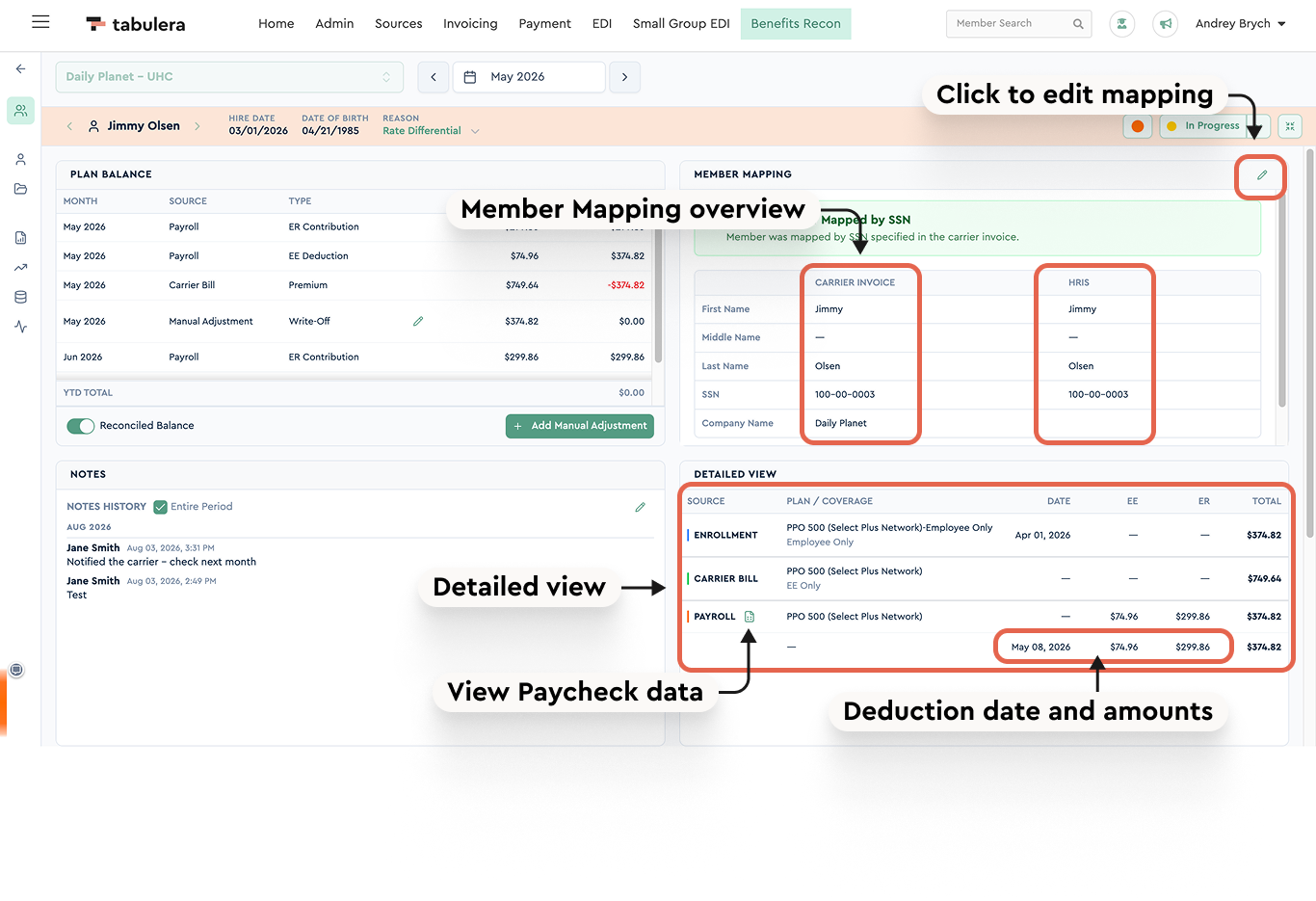
One screen for the whole picture. The new expand button opens the member's full data on a single screen. The date range shows the detailed view for the selected month, and clicking the month reveals every date for which member data exists.
Every source in one panel. The detailed view shows all data the platform holds for the member — including paycheck data, exportable via the icon next to the payroll column.
Notes now keep the whole story. The notes section shows the entire history of notes on the member, not just the current month — so the context from March is still there when the question resurfaces in September.
[[Tip]]The question "why is this employee off by $43?" gets answered on one screen, from data that's already assembled — instead of across three exports and an email thread.[[/Tip]]
Resolving and moving to the next
Once the root cause is identified, add a manual adjustment. It flows into every report and updates the plan balance — write-offs, beginning balances, and period corrections all land in the same place.
The Balance card carries two views worth knowing about.
Plan Balance shows the employee's actual position.
Reconciled Balance shows the same history as a running ledger with every adjustment applied — rounding, payroll frequency, write-offs, and beginning balances. That second view matters most on weekly or bi-weekly payroll, where 26 deductions a year mean some months carry two and others three, so every month shows a variance against a monthly carrier bill. The platform recognizes the pattern, adds a payroll frequency adjustment, and marks those rows auto-resolved instead of leaving them for your team to explain.
The arrows next to the member's name switch you to the next employee in your filtered list, so you can work through a variance queue without returning to the table.
And as before, you can mark variances resolved or in progress, color-code them, and mass-update previous periods for the member.
Reports inside the invoice
Beyond the company-wide reports covered earlier, each invoice carries its own reporting, available right from the reconciliation workspace:
Report
What it gives you
Benefits Reconciliation Report
Invoice totals, manual adjustments, and in-transit items for accounting and GL entries
Source Report
The raw source data behind the current reconciliation
Activity Report
Edits, adjustments, and user actions for this invoice
[[Tip]]When accounting asks for the numbers behind a specific bill, the export comes from the invoice itself — totals, adjustments, and the trail of who changed what.[[/Tip]]
The bottom line
Every change in this update points the same direction: less time navigating, and less time resolving. The invoice list tells you where the issues are. The member view shows you when they started. The reports carry the proof. And the configuration that used to require support tickets — columns, statistics, mapping edits, mid-year fee changes — is now in your hands.
We're rolling out the updated platform to Benefits Reconciliation users now — you'll see the new interface in your account as the rollout reaches you. If you'd like a guided walkthrough with your own data, reach out through the Live Chat button in the platform or send as an email to client.support@tabulera.com
Benefits Open Enrollment: Employer Guide and Checklist
A complete open enrollment guide for employers: when the open enrollment period runs, key dates and deadlines, a step-by-step checklist, and tips that work.
Best HRIS Systems: Top 10 Picks by HR Teams in 2026
Discover the best HRIS systems in 2026. Compare the top 10 HRIS platforms, features, pricing, pros and cons, and find the best HRIS software for your HR team